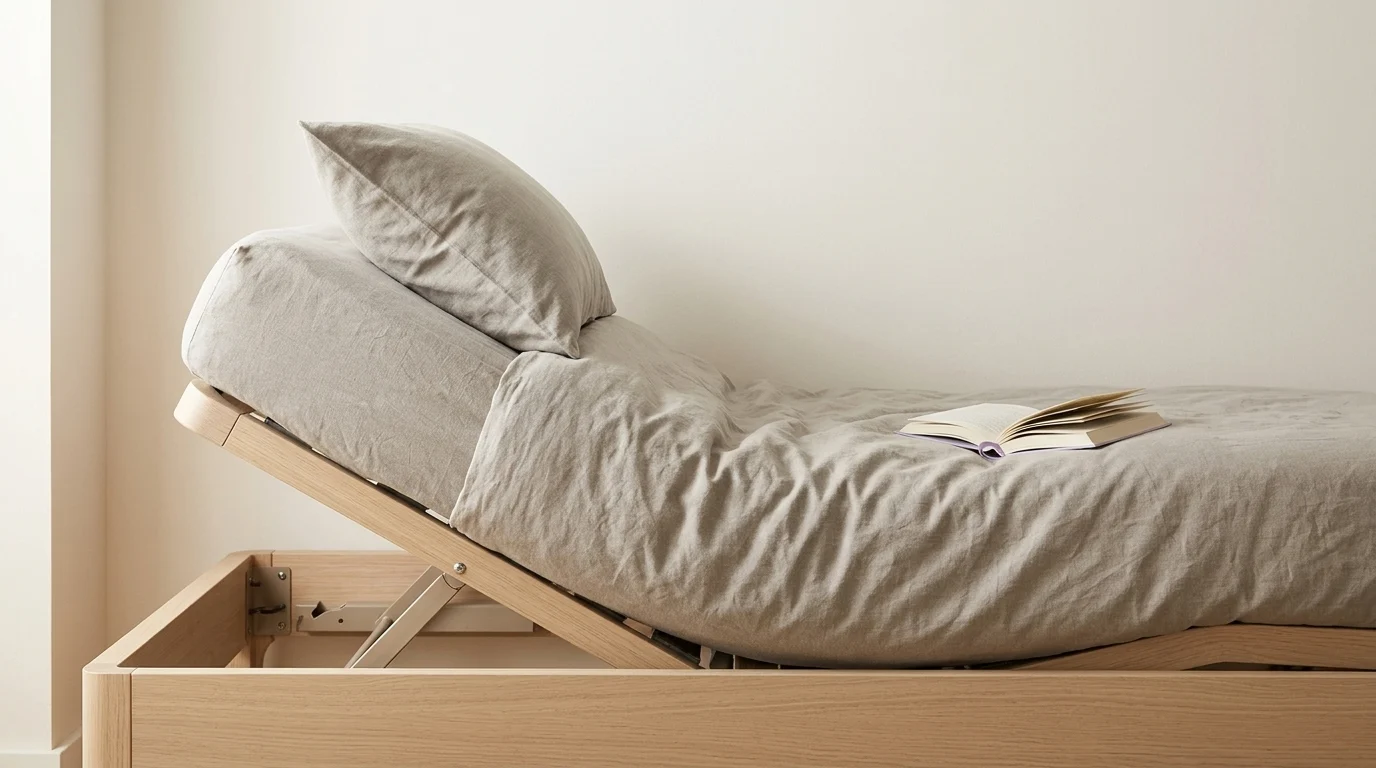
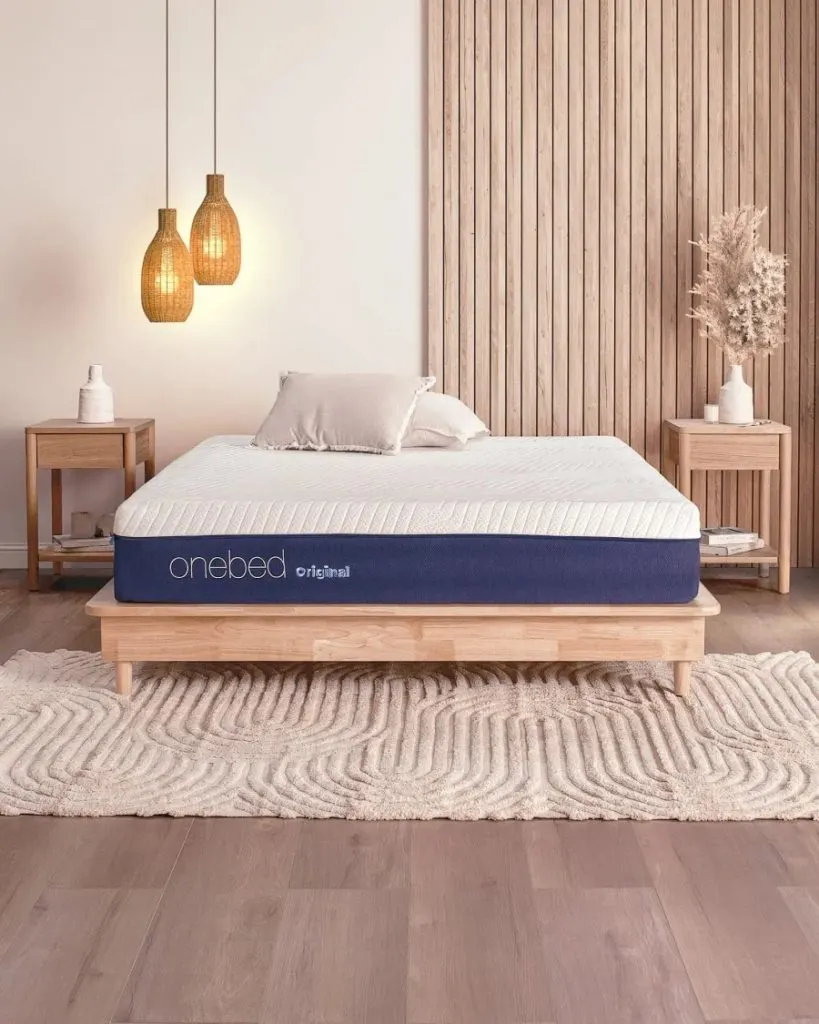
An adjustable base bends your mattress every single night. Most mattresses are not built to take it, and a number of warranties are void the moment you put one on a powered base. On this page the fine print comes before comfort.
Why this list is short
It is short on purpose. Of the nine mattresses on this site, only one names an adjustable base in the brand's own published materials. The rest fall into two groups: those whose warranty documents say nothing at all about powered bases, and those that exclude them.
Silence is the awkward case, and it is the common one. A mattress that is not mentioned either way is not automatically safe — it means nobody has committed to anything, and a warranty claim two years from now will be decided by whoever reads the document then. Rather than fill the page out with mattresses that merely seem likely to cope, we have listed the one where the brand has said so.
If you want a longer shortlist, the section below is how to build one yourself from any mattress you are considering.
Check the warranty first
This is the one mattress category where the paperwork should decide your shortlist before you think about feel. Plenty of brands exclude adjustable-base use outright, and plenty of others allow it only on bases they sell themselves. The exclusion is rarely on the product page — it is in the warranty document.
Ask the retailer to confirm in writing that the specific mattress is warranted for use on an adjustable base. "It should be fine" from a salesperson is not a warranty term.
What flexes and what doesn't
The mattress has to hinge in two places without creasing, gapping or damaging its own structure.
- Generally suitable: all-foam, latex, and hybrids built on individually wrapped pocket springs. Each coil is wrapped and moves on its own, so the spring unit can bend without fighting itself.
- Generally not: continuous-coil and Bonnell innersprings, where the coils are wired together into one rigid unit. Bending them is what breaks them.
- Watch for: rigid foam edge encasement. It is what gives a mattress firm edges, and it is also the part most likely to crack when the mattress articulates repeatedly.
Thickness matters more than people expect
A very thick mattress resists bending, sits higher above the hinge and is more likely to gap at the fold. Thinner profiles articulate more cleanly. If you are choosing between two otherwise similar mattresses, the slimmer one is usually the safer bet on a powered base.
As a rough guide, mattresses around 20 to 28 cm tend to bend cleanly, and anything past about 30 cm needs the brand to have said explicitly that it is designed for it. The mattresses on this site run from 20 cm to 33 cm, so profile alone rules several of them out before construction is even considered.
How to check a mattress that isn't on this list
Five questions, in this order. If you cannot get a straight answer to the first one, the rest do not matter.
- Does the warranty document permit adjustable-base use? Not the product page, not the chat agent — the warranty PDF or the terms of sale. Ask for it in writing and keep the reply.
- Does it permit any adjustable base, or only the brand's own? If only their own, add the base price to the mattress price before comparing anything.
- Is the spring unit pocketed? Wrapped coils bend; linked coils do not. All-foam and latex are fine on this question by default.
- How thick is it, and is the edge foam-encased? Thicker plus rigid encasement is the combination most likely to crease.
- Does the trial still apply on a powered base? Some brands treat a mattress used on an adjustable base as excluded from returns, which removes the safety net exactly where you most need it.
An adjustable base and an adjustable mattress are different things
These get confused constantly, and they solve unrelated problems.
An adjustable base changes the shape of the bed: it raises the head, raises the feet, and holds the mattress in a position other than flat. An adjustable-firmness mattress changes how hard the surface is, usually by flipping the mattress over or by unzipping the cover and rearranging the foam layers inside. Five of the nine mattresses on this site can be reconfigured that way after delivery.
If your problem is "I want to sit up in bed", you need the base. If your problem is "I am not sure whether I want medium or firm", you need the mattress — and it is the cheaper of the two fixes by a wide margin. Buying a powered base to solve a firmness problem is an expensive way to not solve it.
The base side of the equation
- Retainer bar. Without a bar or bracket at the foot, the mattress creeps down the base every time you raise the head. Confirm the base has one, or that one is available.
- Weight limit. Adjustable bases have a rated capacity that includes the mattress. Latex and thick hybrids are heavy — check the mattress weight against the base rating, not just against your own.
- Size. Many adjustable bases sold in Australia are King Single, or a split King made from two King Singles side by side. A split configuration means two mattresses, not one — and each partner can choose their own firmness, which is one of the genuine advantages.
- Clearance. Check what is above the bed and behind the headboard. A base at full incline needs more room than the flat footprint suggests.
What to expect from the mattress itself
A mattress that handles articulation well tends to be more flexible everywhere, which usually means a softer edge and a bit more give when you sit on the side of the bed. That is a trade-off, not a fault — but if you rely on a firm edge to get in and out of bed, weigh it deliberately.
Motion isolation matters more on a split base than a standard one, since the two halves move separately. Pressure relief matters more too: in a raised position your weight concentrates differently, generally more through the hips and lower back.
Living with one, beyond the first week
The things people complain about a year in are rarely about the mattress.
- Sheets. Flat sheets come untucked the first time you raise the head. Deep-pocket fitted sheets and a doona rather than a tucked top sheet are the usual fix; some people use sheet straps.
- The headboard. Most adjustable bases are freestanding and do not attach to an existing bed frame. If you want to keep your headboard, check whether a bracket kit exists for that base before you buy.
- Cables and the remote. The base needs mains power near the head of the bed, and the cable has to have enough slack to move with it. Check where the plug will actually sit.
- Power failure. Most bases have either a battery backup or a manual release so the bed can be lowered without power. Find out which one yours has before you need it.
- Noise. Motors are audible. If the bed is shared and one partner adjusts it after the other is asleep, that matters more than the specification sheet suggests.
- Rotation. Warranties frequently require the mattress to be rotated on a schedule. On a powered base that means lifting it off the retainer bar, which is a two-person job on a heavy hybrid.
Who tends to buy one
Adjustable bases are commonly bought for reading and watching television in bed, for reducing snoring by sleeping with the head slightly raised, for reflux symptoms, and for making it easier to get in and out of bed. Some people simply find a slight incline more comfortable.
To be clear about what this page is: a mattress and a bed base are consumer products, not treatments, and nothing here is medical advice. If you are buying one because of a health condition, the useful conversation is with a health professional first and a retailer second — including on the question of what angle actually helps, which is not something a mattress specification can answer.
Before you buy
- Confirm in writing that adjustable-base use does not void the warranty.
- Confirm the base's weight rating covers your mattress.
- Confirm the trial period still applies when the mattress is used on a base — some brands treat it differently.
- Confirm whether the base requires the brand's own mattress, and price accordingly.
- Measure the room at full incline, not flat.
Common questions
Can I put my current mattress on an adjustable base?
Physically, often yes. Within warranty, frequently no. Check the warranty document for the mattress you already own before spending money on the base — the cost of finding out afterwards is a mattress, not a base.
Will an adjustable base wear the mattress out faster?
A mattress rated for it should last a normal life. A mattress not rated for it can develop a permanent crease at the hinge line, and that crease is exactly the kind of indentation warranties exclude when the mattress has been used in an unapproved way.
Do I need a special mattress protector?
No, but a fitted protector will stay put better than a flat one, and most warranties require a protector anyway — staining voids a large number of mattress warranties outright.
Is a split King two mattresses or one?
Two, each King Single sized, sitting side by side on two halves that move separately. It is the configuration that lets two people choose their own firmness and their own angle, which is the main reason a couple would choose a split base over a single one.